

Online money transfer is not a simple “send-and-receive” action. Instead, it is a multi-stage financial routing process involving payment networks, intermediary institutions, compliance checks, and settlement systems. While most users tap “Send” and assume money travels instantly to the recipient, the reality is far more complex. Each transaction moves through a structured financial pipeline where it is validated, screened, routed, cleared, settled, and finally credited.
Understanding this hidden infrastructure is essential if you want to reduce fees, avoid delays, and minimize risks. Rather than relying on a specific app or service, knowing how the system works allows you to make smarter financial decisions.
What is an Online Money Transfer?
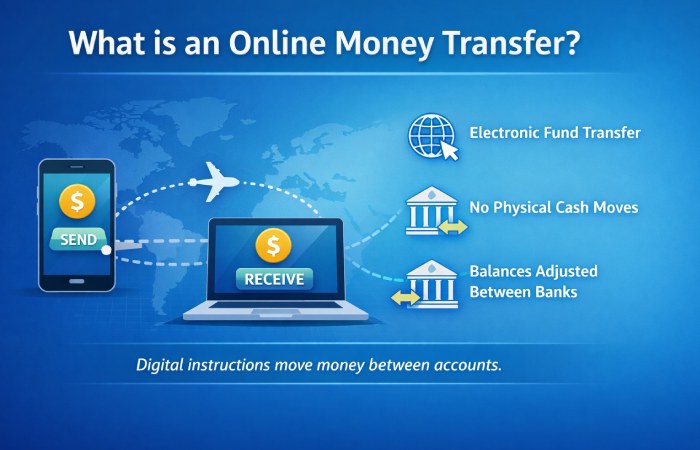
An online money transfer refers to the electronic movement of funds between accounts using internet-enabled systems instead of physical cash or paper instruments. These transfers rely on digital instructions rather than the physical movement of money.
In most cases, money does not “travel” in a literal sense. Instead, financial institutions adjust balances in their internal ledgers or accounts held with one another. This concept is explained in detail by the Bank for International Settlements, which highlights how settlement systems operate globally.
Common Use Cases
| Use Case | Example |
| Personal payments | Sending money to family |
| Bills & rent | Utility or housing payments |
| Income transfers | Freelance or salary payments |
| Shopping | E-commerce purchases |
| Education & healthcare | Tuition or medical fees abroad |
The End-to-End Lifecycle of an Online Transfer
Every online transfer goes through a structured lifecycle. While it appears instant on the surface, multiple steps happen behind the scenes.
The process begins with payment initiation, where the sender enters recipient details and selects a funding source such as a bank account, debit card, or digital wallet. At this stage, the system checks account balances and transaction limits.
Next comes identity verification and fraud screening. Financial institutions use authentication methods like OTPs, passwords, and biometric checks. Advanced fraud detection systems analyze user behavior, device information, and transaction patterns. According to the World Bank, such checks are essential to reduce financial crime in digital transactions.
After verification, the transaction is routed through payment rails. These rails act as highways for financial data. Domestic payments typically use national systems, while international transfers may pass through multiple correspondent banks.
The most critical stage is clearing and settlement, where delays usually occur. Clearing confirms obligations between institutions, while settlement is the actual movement of funds between banks. Some systems operate in real time, while others process transactions in batches to reduce risk.
Finally, the recipient’s bank credits the funds. However, availability may still depend on internal policies, compliance checks, or timing cut-offs.
Transfer Lifecycle Overview
| Stage | Description | Key Risk |
| Initiation | User inputs details and amount | Input errors |
| Verification | Identity & fraud checks | Delays |
| Routing | Payment travels via networks | Intermediaries |
| Clearing | Obligations confirmed | Processing lag |
| Settlement | Funds transferred between banks | System delays |
| Credit | Receiver gets funds | Availability rules |
Domestic vs International Transfers
Domestic and international transfers behave differently due to infrastructure, regulation, and currency factors. Domestic transfers are usually faster and cheaper because they operate within a single financial system.
International transfers, on the other hand, require currency conversion, regulatory checks, and often involve multiple intermediary banks. This increases both cost and processing time.
| Factor | Domestic | International |
| Speed | Seconds to hours | Hours to days |
| Currency conversion | Not required | Required |
| Intermediaries | Few | Multiple |
| Cost | Low or free | Moderate to high |
Major Types of Online Money Transfer Methods
There are several methods available today, each designed for specific use cases. Bank transfers remain the most traditional option, while real-time payment systems and fintech platforms offer faster alternatives.
Digital wallets such as PayPal allow users to send money using email or phone numbers. Meanwhile, fintech services like Wise reduce costs by using local banking networks instead of traditional correspondent banking systems.
Cash pickup services, such as Western Union, provide accessibility for recipients without bank accounts.
Comparison of Transfer Methods
| Method | Speed | Cost | Best For | Limitation |
| Bank transfer | Medium | Low | Large payments | Not always instant |
| Real-time systems | Instant | Free/low | Daily payments | Domestic only |
| Digital wallets | Instant | Low–medium | Small transfers | Platform dependency |
| Fintech cross-border | Fast | Low–medium | International | Limits apply |
| Cash pickup | Fast | Medium–high | Unbanked users | Physical collection |
Payment Infrastructure: Why Money Rarely “Moves”
One of the most misunderstood aspects of online transfers is that money rarely moves physically. Instead, institutions adjust balances across interconnected systems.
Payment rails carry transaction instructions, clearing systems confirm obligations, and settlement systems handle fund transfers between banks. Correspondent banks bridge international gaps, while card networks process card-based payments.
| Component | Role |
| Payment rails | Carry transaction instructions |
| Clearing systems | Confirm obligations |
| Settlement systems | Move funds between banks |
| Correspondent banks | Enable global transfers |
| Card networks | Handle card transactions |
How Long Transfers Actually Take
Transfer time varies depending on the method used and external factors such as compliance checks and intermediary involvement.
Instant domestic transfers can complete within seconds, while traditional international wire transfers may take several days due to multiple intermediaries and regulatory checks.
| Method | Time | Delay Factors |
| Instant domestic | Seconds | Network uptime |
| Bank transfer | Minutes–hours | Batch processing |
| Fintech international | Minutes–2 days | Compliance checks |
| Wire transfer | 2–5 days | Intermediaries |
| Cash pickup | Minutes–hours | Agent availability |
The Real Cost of Sending Money Online
The true cost of online transfers is often misunderstood because not all fees are visible. While users may see a transfer fee upfront, hidden costs such as exchange rate margins and intermediary charges can significantly increase the total expense.
The World Bank reports that exchange rate margins are one of the largest contributors to global remittance costs.
| Cost Type | Visibility | Description |
| Transfer fee | Visible | Charged by provider |
| Exchange margin | Hidden | Currency markup |
| Intermediary fee | Often hidden | Charged by middle banks |
| Receiving fee | Sometimes hidden | Deducted on arrival |
| Card fee | Visible | For card payments |
Security Mechanisms in Online Transfers
Online transfers are protected by multiple layers of security designed to safeguard both users and institutions. Encryption ensures that data remains secure during transmission, while multi-factor authentication verifies user identity.
Fraud monitoring systems analyze transactions in real time, and regulatory frameworks enforce compliance standards globally.
| Security Layer | Purpose |
| Encryption | Protects data |
| Multi-factor authentication | Verifies identity |
| Fraud monitoring | Detects suspicious activity |
| Transaction limits | Reduces risk |
| Regulatory oversight | Ensures compliance |
Risks and Limitations
Despite strong security measures, online transfers are not risk-free. Errors, scams, and compliance issues can still affect transactions.
Incorrect recipient details remain one of the most common issues, while social engineering scams continue to rise globally. Additionally, instant payments are often irreversible, making caution essential before confirming a transfer.
| Risk | Cause | Mitigation |
| Wrong recipient | Input error | Double-check details |
| Scams | Social engineering | Avoid unknown recipients |
| Irreversibility | Instant settlement | Review before sending |
| Compliance holds | Suspicious activity | Provide documents |
Choosing the Right Transfer Method
Selecting the best transfer method depends on your specific situation rather than a single “best” platform. Daily local payments are best handled through instant systems, while large transactions may require traditional banking channels.
For international transfers, fintech services often provide the best balance of speed and cost. Cash pickup options remain essential for recipients without access to banking services.
| Scenario | Recommended Method | Reason |
| Daily payments | Instant system | Fast and free |
| Large transfers | Bank transfer | Higher limits |
| Cheap international | Fintech | Lower cost |
| Urgent overseas | Card-based fintech | Speed |
| No bank access | Cash pickup | Accessibility |
The Future of Online Money Transfers
The future of online money transfers is being shaped by technological innovation and global collaboration. Real-time international payment systems are being developed to reduce delays, while digital currencies may lower transaction costs further.
Organizations such as the Bank for International Settlements are actively working on improving cross-border payment efficiency. Artificial intelligence is also playing a growing role in fraud detection and risk management.
| Trend | Impact |
| Real-time global payments | Faster transfers |
| Digital currencies | Lower costs |
| Embedded payments | Seamless transactions |
| AI fraud detection | Improved security |
| Fewer intermediaries | Reduced fees |
Conclusion
Online money transfer is best understood as a financial logistics system rather than a simple transaction. Behind every payment lies a structured process involving verification, routing, clearing, and settlement.
By understanding how these stages work, you gain the ability to predict transfer speed, identify hidden costs, and minimize risks. Whether you are sending money locally or internationally, inform decisions—not just app choices—are the key to faster, cheaper, and safer transactions.