

In an increasingly digital world, where professional interactions often happen through emails, messaging apps, and social media platforms, the business card remains a powerful and timeless networking tool. It continues to play a vital role in establishing credibility, reinforcing brand identity, and making memorable first impressions.
A business card is not just a piece of printed material; it is a compact representation of your professional identity. Whether handed out during meetings, conferences, or casual introductions, it acts as a tangible reminder of who you are and what you offer. Its simplicity and effectiveness make it an essential tool for professionals across industries.
What is a Business Card?
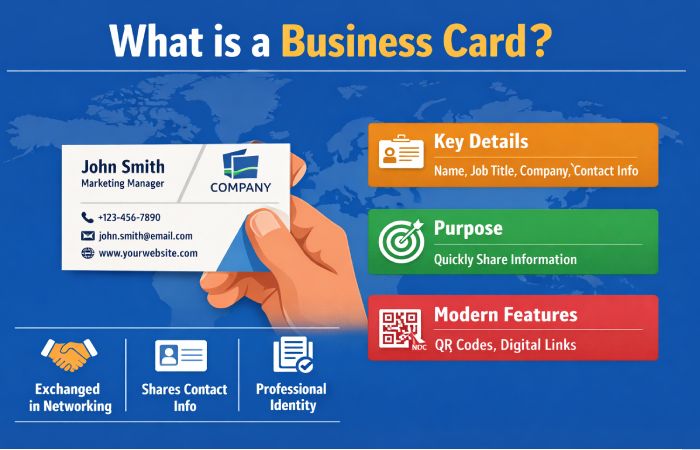
A business card is a small card that contains key information about an individual or a company. It is typically exchanged during formal or informal professional interactions to facilitate communication and future contact. According to Wikipedia, business cards usually include details such as the person’s name, company name, job title, and contact information.
Over time, business cards have evolved beyond basic contact details. Today, they may also include QR codes, social media handles, and links to digital portfolios, making them more interactive and versatile.
The Evolution of Business Cards
The concept of business cards can be traced back to 17th-century Europe, where “visiting cards” were used by the aristocracy as a way to introduce themselves and announce visits. These early cards were more about social etiquette than business.
With the expansion of trade and commerce during the Industrial Revolution, business cards transitioned into commercial tools. Merchants and professionals began using them to promote their services and share their contact details.
In the modern era, advancements in printing and design technologies have transformed business cards into creative branding tools. Today, they come in a wide range of materials, finishes, and formats, blending traditional functionality with modern innovation.
Importance of Business Cards in Modern Networking
Despite the convenience of digital communication, business cards remain highly relevant because they offer a personal touch that digital exchanges often lack. When someone hands you a business card, it creates a moment of connection that is difficult to replicate through a screen.
Business cards also contribute significantly to brand perception. A well-designed card reflects professionalism and attention to detail, which can influence how others perceive your business. In many cases, the quality and design of the card can leave a lasting impression that reinforces your credibility.
Additionally, business cards serve as a quick and efficient way to share information without relying on technology. In situations where internet access is limited or time is short, they provide a reliable alternative.
Essential Elements of a Business Card
A business card must balance clarity and design while presenting all necessary information. The following table outlines the core components and their significance.
Essential Elements
| Element | Description | Role in Communication |
| Name | Full name of the individual | Establishes identity |
| Company Name | Business or organization name | Builds brand recognition |
| Job Title | Professional designation | Clarifies role |
| Contact Information | Phone, email, address | Enables communication |
| Logo | Visual representation of brand | Enhances recall |
| Website | Online presence | Provides more details |
| QR Code | Digital access tool | Connects offline to online |
Each of these elements contributes to making the card both functional and visually appealing. The goal is to ensure that the recipient can quickly understand who you are and how to reach you.
Types of Business Cards
Business cards vary widely in design and purpose, depending on the industry and personal branding strategy. Some cards emphasize simplicity, while others focus on creativity and uniqueness.
Types Overview
| Type | Description | Ideal Usage |
| Standard | Traditional rectangular card | Corporate environments |
| Minimalist | Clean and simple design | Modern professionals |
| Creative | Unique shapes or layouts | Designers and artists |
| Luxury | Premium materials and finishes | High-end brands |
| Digital | Virtual or app-based cards | Tech-oriented users |
| Eco-Friendly | Made from recycled materials | Sustainable businesses |
The choice of card type should align with your brand identity and the message you want to convey. For instance, a luxury brand may benefit from a premium card, while a creative professional might opt for a unique design.
Design Principles for an Effective Business Card
Design plays a crucial role in determining how effective a business card will be. A well-designed card not only looks appealing but also communicates information clearly.
Clarity is one of the most important aspects of design. The text should be easy to read, with a font size and style that ensures readability. Overly decorative fonts can make the card difficult to understand and should be used sparingly.
Color selection is another key factor. Colors should reflect your brand identity while maintaining a professional appearance. Neutral tones often convey trust and reliability, while brighter colors can express creativity and energy.
The layout should be balanced, ensuring that no section appears overcrowded. Proper spacing between elements improves readability and enhances the overall visual appeal. Including a logo further strengthens brand recognition and makes the card more memorable.
Design Elements and Their Impact
Design Elements
| Element | Description | Impact on Card |
| Color Scheme | Use of brand colors | Strengthens identity |
| Typography | Font style and size | Improves readability |
| Layout | Arrangement of elements | Enhances clarity |
| Material | Paper or alternative medium | Reflects quality |
| Finish | Matte, glossy, or textured | Adds visual appeal |
Each design element contributes to the overall effectiveness of the business card, influencing how it is perceived by the recipient.
Physical vs Digital Business Cards
The rise of technology has introduced digital business cards as an alternative to traditional printed ones. However, both formats have their own advantages and limitations.
Comparison Table
| Feature | Physical Card | Digital Card |
| Format | Printed material | Digital file or app |
| Accessibility | No device needed | Requires device |
| Interaction | Personal exchange | Online sharing |
| Cost | Printing expenses | Often low-cost |
| Memorability | High | Moderate |
Physical cards provide a tactile experience that enhances personal connection, while digital cards offer convenience and easy sharing. Many professionals now use a combination of both to maximize their networking potential.
Creating a Business Card
The process of creating a business card begins with understanding your brand and target audience. A clear idea of your professional identity helps guide design decisions and ensures consistency.
Once the concept is defined, the next step involves selecting a layout and adding essential information. Careful attention should be given to typography, color, and spacing to ensure clarity and visual balance. After finalizing the design, proofreading is crucial to avoid errors that could affect credibility.
Printing should be done using high-quality materials to enhance durability and presentation. Alternatively, digital versions can be created for online sharing, offering additional flexibility.
Common Mistakes in Business Card Design
Even though business cards are small, mistakes in their design can significantly impact their effectiveness.
Mistakes
| Mistake | Issue Caused | Recommended Fix |
| Overcrowded Layout | Reduces readability | Simplify content |
| Tiny Fonts | Hard to read | Use larger text |
| Poor Quality Material | Looks unprofessional | Use premium paper |
| Missing Information | Limits usability | Include essentials |
| Inconsistent Branding | Confuses audience | Align with brand |
Avoiding these mistakes ensures that the card remains functional and professional.
Role of Business Cards in Branding
Business cards serve as a direct extension of your brand. Every element, from the logo to the color scheme, contributes to how your brand is perceived. A consistent design across all marketing materials reinforces brand recognition and builds trust among clients and partners.
Moreover, business cards act as a subtle marketing tool. When shared with potential clients or collaborators, they provide a snapshot of your business and encourage further engagement.
Future Trends in Business Cards
As technology continues to evolve, business cards are adapting to incorporate new features and trends. Many modern cards now include QR codes that link to websites, portfolios, or social media profiles. Some even use NFC technology to enable contactless sharing.
Sustainability is another growing trend, with businesses opting for eco-friendly materials to reduce environmental impact. Minimalist designs are also gaining popularity, reflecting a shift toward simplicity and clarity.
Despite these advancements, the core purpose of business cards remains unchanged: to facilitate connection and communication in a professional setting.
Conclusion
A business card continues to be an essential tool in professional networking, bridging the gap between traditional and digital communication. Its ability to convey key information quickly, create lasting impressions, and reinforce brand identity makes it invaluable in today’s competitive environment.
By focusing on clear design, essential information, and consistent branding, professionals can create business cards that not only serve their purpose but also stand out. Whether in physical or digital form, a well-crafted business card remains a powerful representation of your professional identity.