

Startup Content Strategy face a structural disadvantage: they must earn visibility, trust, and customers faster than incumbents with far fewer resources. Generative AI appears to level the field by making content cheap and fast—but speed alone produces a flood of indistinguishable material. Many founders discover that publishing dozens of AI-written articles changes nothing: traffic stays low, leads don’t materialize, and brand credibility suffers.
The real solution is not more content but smarter content produced through an AI-native operating model. When used strategically, generative AI enables a small team to research like analysts, produce like a newsroom, personalize like an enterprise, and distribute like a media company. In short, it turns content from a marketing activity into a growth function.
Why Generative AI Changes Content Economics for Startups
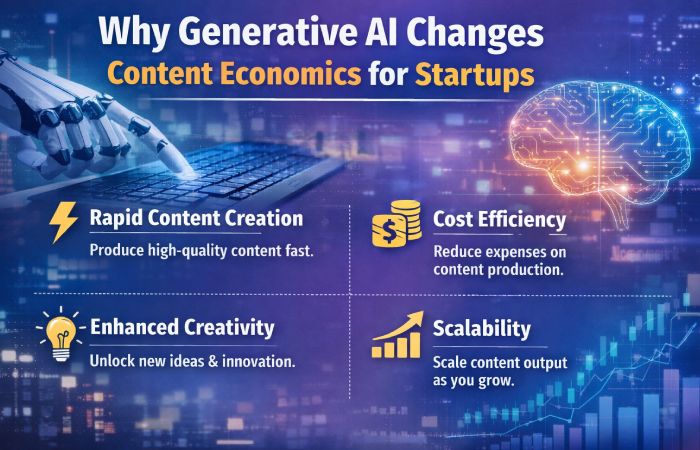
Traditional content marketing scales linearly: more output requires more people. Generative AI introduces leverage, shifting the constraint from production capacity to strategic clarity.
| Dimension | Traditional Model | AI-Native Model |
| Cost driver | Hiring and agencies | Software + expertise |
| Speed of production | Slow | Rapid |
| Output ceiling | Limited | High |
| Personalization | Expensive | Scalable |
| Barrier to entry | High | Low |
Research from organizations such as McKinsey & Company suggests AI can dramatically increase knowledge-worker productivity. Yet productivity alone does not create advantage; many companies will gain it simultaneously. What differentiates startups is how quickly they convert that productivity into learning and market insight.
The AI-Native Content Strategy Framework
Align Content With Decisions, Not Just Interest
Startups often publish educational material that attracts readers but not buyers. Decision-stage content, by contrast, speaks to people evaluating solutions.
| Awareness Topic | Decision Topic |
| “What is project management software?” | “Best project management tools for remote startups under 20 people” |
Both are easy for AI to produce. Only the latter influences purchasing behavior.
Guidelines from Google emphasize usefulness and expertise, particularly for content affecting decisions. For startups, usefulness is measured by whether the content helps someone choose or adopt a solution.
Build Authority Through Insight, Not Volume
Generic summaries are becoming commoditized. What remains scarce is lived experience: trade-offs, constraints, mistakes, and practical advice that cannot be scraped from existing pages.
High-authority startup content typically includes concrete scenarios. For example, a founder explaining why they chose one infrastructure provider over another—and what went wrong during migration—offers more value than a neutral overview of options.
Institutions such as MIT and Stanford University have documented how AI excels at synthesis but not at original judgment. This distinction is central: AI aggregates; humans differentiate.
Use Personalization to Capture Long-Tail Demand
Before AI, creating tailored content for multiple industries or roles was cost-prohibitive. Now it is routine.
| Broad Page | Segmented Pages |
| One guide for all users | Industry-specific versions |
| Generic messaging | Role-focused guidance |
| High competition | Lower competition |
| Lower conversion | Higher relevance |
A startup selling analytics software, for instance, might publish separate guides for ecommerce brands, SaaS companies, and marketplaces. Each addresses distinct problems and terminology, increasing conversion likelihood.
Treat Content as an Iterative System
AI enables rapid updates, turning content into a living asset rather than a static publication. A practical cycle looks like this:
- Publish quickly with reasonable completeness
- Observe engagement, search queries, and sales feedback
- Add missing sections or clarify confusion points
- Expand into adjacent topics
This loop favors startups because they can adapt faster than large organizations burdened by approval layers.
Content Formats That Produce Measurable Business Impact
Not all content contributes equally to growth. Certain formats align closely with buying behavior.
| Content Type | Strategic Role |
| Comparison pages | Help evaluators choose between options |
| Alternatives pages | Capture competitor-aware traffic |
| Pricing guides | Address budget concerns directly |
| Implementation playbooks | Reduce perceived risk |
| Case studies | Demonstrate real outcomes |
| Templates or tools | Provide immediate utility |
| Founder perspectives | Build trust and authenticity |
These formats move prospects closer to action rather than simply increasing page views.
The AI-Augmented Content Workflow
Generative AI reshapes every stage of production, but human judgment remains essential at key points.
| Stage | AI Contribution | Human Contribution |
| Opportunity discovery | Pattern analysis | Prioritization |
| Research | Rapid synthesis | Validation |
| Drafting | Structure and text | Insight and voice |
| Editing | Language refinement | Clarity and accuracy |
| Optimization | Suggestions | Strategic decisions |
| Distribution prep | Format variations | Channel selection |
AI acts like a highly capable junior analyst. It accelerates work but still requires supervision.
Tool Selection Matters Less Than Process Discipline
Startups often chase new tools hoping for breakthrough results. In practice, consistent workflows outperform fragmented experimentation.
| Function | Purpose |
| Research tools | Identify topics and gaps |
| Writing models | Generate drafts |
| SEO platforms | Prioritize opportunities |
| Design tools | Produce visuals |
| Automation systems | Assist distribution |
| Analytics platforms | Measure outcomes |
A small, well-integrated stack is usually more effective than a sprawling collection of specialized software.
SEO in the Era of AI-Generated Answers
Search is shifting toward synthesized responses rather than lists of links. Content most likely to be cited tends to share several characteristics:
| Feature | Why It Matters |
| Clear structure | Easy extraction |
| Direct answers | Matches user intent |
| Authoritative tone | Signals expertise |
| Updated information | Maintains relevance |
| Practical examples | Enhances usefulness |
Publishing more pages without authority signals often yields diminishing returns. Depth increasingly beats breadth.
Distribution: The Critical Multiplier
Production is only half the equation. Many startup articles receive little attention simply because they are not actively promoted.
| Distribution Channel | Why It Works |
| Founder social presence | Builds trust and reach |
| Industry communities | Highly targeted audience |
| Partnerships | Borrowed credibility |
| Email newsletters | Owned distribution |
| Sales outreach | Direct pipeline impact |
Two startups with similar content can experience vastly different outcomes depending on distribution intensity. Visibility accelerates authority, which in turn improves organic performance.
Risks and Governance Considerations
Generative AI introduces new operational challenges that cannot be ignored.
| Risk | Consequence | Mitigation |
| Factual inaccuracies | Loss of credibility | Verification processes |
| Brand inconsistency | Confusing messaging | Style guidelines |
| Legal exposure | Compliance issues | Source review |
| Over-automation | Generic output | Human checkpoints |
Regional regulations may also influence strategy. For example, strict data-protection rules in Europe affect personalization practices and analytics tracking.
A Practical 90-Day Adoption Roadmap
Month 1 — Foundation
Focus on defining the audience, mapping high-intent topics, and producing several cornerstone pieces that address core decisions.
Month 2 — Authority Building
Shift toward comparison guides, implementation advice, and other decision-stage material while beginning active distribution through founder channels and communities.
Month 3 — Scaling and Optimization
Repurpose successful content into multiple formats, expand into adjacent niches, and refine conversion paths based on observed behavior.
This phased approach balances speed with strategic coherence.
Why Many AI Content Initiatives Fail
Failure rarely stems from the technology itself. More often, organizations fall into predictable traps: prioritizing traffic over customers, publishing generic material, neglecting distribution, or measuring success by output volume instead of business outcomes.
AI amplifies both competence and confusion. Without clear goals, it accelerates the latter.
The Emerging Advantage of AI-Native Startups
Companies that integrate AI deeply into their operating model develop capabilities that are difficult to replicate: rapid experimentation, continuous publishing cycles, and the ability to adapt messaging as markets evolve.
Content becomes not merely a marketing channel but a feedback system connecting customers, product teams, and leadership.
Conclusion
Generative AI gives startups unprecedented leverage, but leverage without direction produces minimal value. The real opportunity lies in combining machine efficiency with human judgment to create material that genuinely helps people make decisions.
Startups that adopt this AI-native approach transform content from a cost center into a strategic asset—one capable of competing with organizations many times larger. The winners will not be those who publish the most, but those who learn the fastest and communicate the clearest.