

In the rapidly evolving landscape of education, traditional methods of teaching mathematics in high schools are being reexamined more critically than ever before. For decades, math classrooms have relied heavily on lecture-based instruction, rote memorization, and standardized problem-solving techniques. While these methods have produced results for some learners, they often fail to engage a broader and more diverse student population. Many students perceive mathematics as abstract, disconnected from real life, and difficult to relate to—leading to disengagement, anxiety, and underperformance.
Today, the urgency to adopt innovative teaching strategies is undeniable. Modern learners require dynamic, interactive, and personalized educational experiences that align with the digital age and real-world demands. Educators are increasingly exploring creative approaches such as integrating technology, implementing project-based learning, adopting flipped classrooms, and fostering collaboration. These methods not only make mathematics more engaging but also emphasize its relevance in everyday life and future careers.
This article provides a comprehensive exploration of these transformative approaches, combining in-depth analysis with structured tables to offer clarity and practical insights.
Embracing Technology in the Classroom
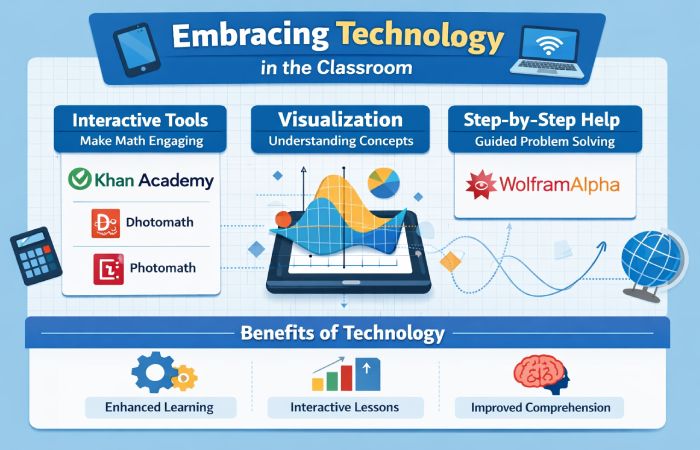
Technology has revolutionized the way mathematics is taught and learned. Digital tools allow students to visualize complex concepts, interact with mathematical models, and receive instant feedback. Instead of passively consuming information, students actively engage with content through simulations, apps, and interactive platforms.
Platforms like Khan Academy and Desmos have made high-quality math education accessible to millions. Meanwhile, tools such as Photomath and Wolfram Alpha provide step-by-step solutions that encourage independent learning.
Technology not only enhances understanding but also supports differentiated instruction—allowing teachers to cater to students at varying skill levels.
Key Technologies in Math Education
| Technology Tool | Purpose | Benefits | Example Use Case |
| Graphing Software | Visualizing equations | Improves conceptual understanding | Plotting quadratic functions |
| Educational Apps | Practice & self-learning | Personalized learning pace | Solving algebra problems |
| Virtual Manipulatives | Hands-on learning | Makes abstract concepts tangible | Geometry transformations |
| AI-Based Tools | Adaptive learning | Real-time feedback | Customized quizzes |
| Online Platforms | Supplemental learning | Accessible anytime | Homework support |
Project-Based Learning (PBL)
Project-Based Learning shifts the focus from theoretical instruction to real-world application. Instead of solving isolated problems, students work on extended projects that require critical thinking, collaboration, and creativity.
For example, students may design a business plan, manage a budget, or analyze environmental data. These projects integrate mathematical concepts such as percentages, ratios, and statistics into meaningful contexts.
PBL fosters deeper understanding because students see how math applies outside the classroom. It also improves retention, as learners actively construct knowledge rather than passively receiving it.
Project-Based Learning Structure
| Component | Description | Student Outcome |
| Driving Question | Real-world problem | Encourages curiosity |
| Research | Data collection & analysis | Builds analytical skills |
| Application | Applying math concepts | Enhances understanding |
| Collaboration | Group work | Improves communication |
| Presentation | Sharing results | Boosts confidence |
Flipped Classroom Model
The flipped classroom is an instructional strategy where students learn new content at home and apply it in class. This reverses the traditional teaching model.
Students watch video lectures or read materials before class, freeing up classroom time for discussions, problem-solving, and interactive activities. This approach allows teachers to provide personalized support and focus on deeper learning.
The flexibility of this model accommodates different learning speeds. Students can pause, rewind, or revisit lessons as needed, ensuring better comprehension.
Traditional vs Flipped Classroom
| Aspect | Traditional Classroom | Flipped Classroom |
| Learning Time | In-class lectures | At-home learning |
| Practice | Homework | In-class activities |
| Teacher Role | Lecturer | Facilitator |
| Student Role | Passive | Active |
| Engagement Level | Moderate | High |
Collaborative Learning and Peer Tutoring
Collaboration transforms math learning into a social and interactive experience. When students work together, they exchange ideas, explain concepts, and learn from different perspectives.
Peer tutoring is particularly effective because students often feel more comfortable asking questions in a peer setting. It also reinforces learning for tutors, as teaching others deepens their understanding.
Group activities like “think-pair-share” and math stations encourage participation and teamwork.
Collaborative Learning Methods
| Method | Description | Benefits |
| Think-Pair-Share | Discuss ideas in pairs | Improves communication |
| Group Projects | Team-based tasks | Builds teamwork |
| Peer Tutoring | Student-led teaching | Enhances understanding |
| Math Circles | Discussion groups | Encourages exploration |
| Study Groups | Informal collaboration | Reinforces learning |
Gamification in Math Education
Gamification introduces game elements such as points, badges, and leaderboards into learning. This approach taps into students’ natural motivation for competition and achievement.
Math games, quizzes, and challenges make learning fun and interactive. For instance, a classroom economy system or a math treasure hunt can significantly boost engagement.
Research shows that gamification improves retention and encourages consistent participation.
Gamification Elements
| Element | Description | Impact |
| Points | Reward system | Encourages effort |
| Badges | Achievement markers | Builds motivation |
| Leaderboards | Ranking system | Promotes competition |
| Challenges | Problem-solving tasks | Enhances skills |
| Rewards | Incentives | Boosts engagement |
Real-World Applications of Mathematics
Connecting math to real-life situations increases its relevance and importance. When students understand how math applies to daily life, they become more interested and motivated.
Examples include analyzing social media statistics, calculating budgets, or studying population growth. Guest speakers from industries such as engineering, finance, and technology can further demonstrate practical applications.
Real-World Math Applications
| Field | Application | Math Concept |
| Finance | Budgeting & investments | Percentages |
| Healthcare | Disease modeling | Statistics |
| Engineering | Structural design | Geometry |
| Technology | Algorithms | Algebra |
| Environment | Climate analysis | Data interpretation |
The Impact of IB Maths
The International Baccalaureate Maths program is widely recognized for its rigorous and comprehensive approach. It emphasizes critical thinking, problem-solving, and real-world application.
Students engage with advanced topics and develop analytical skills that prepare them for higher education and careers.
IB Maths Curriculum Overview
| Level | Focus | Skills Developed |
| Standard Level | Core concepts | Problem-solving |
| Higher Level | Advanced topics | Analytical thinking |
| Internal Assessment | Research project | Application skills |
| Exams | Concept mastery | Critical reasoning |
Teacher Training and Professional Development
Innovative teaching requires well-trained educators. Continuous professional development ensures that teachers stay updated with modern methodologies and technologies.
Workshops, online courses, and collaborative communities provide opportunities for growth and knowledge sharing.
Professional Development Strategies
| Strategy | Description | Benefit |
| Workshops | Hands-on training | Skill enhancement |
| Online Courses | Flexible learning | Accessibility |
| Peer Collaboration | Idea sharing | Innovation |
| Conferences | Networking | Exposure to trends |
| Coaching | Personalized guidance | Improved teaching |
Future Trends in Math Education
The future of math education is driven by emerging technologies such as artificial intelligence, virtual reality, and machine learning. These innovations promise personalized learning experiences and immersive environments.
AI can analyze student performance and adapt lessons accordingly, while VR can create interactive simulations for complex concepts.
Emerging Trends
| Technology | Application | Potential Impact |
| Artificial Intelligence | Adaptive learning | Personalized education |
| Virtual Reality | Immersive learning | Better visualization |
| Augmented Reality | Interactive models | Enhanced engagement |
| Machine Learning | Data analysis | Improved outcomes |
| Blockchain | Credentialing | Secure records |
Conclusion
The transformation of high school mathematics education is no longer optional—it is essential. Traditional teaching methods, while foundational, must evolve to meet the needs of modern learners. By integrating technology, adopting project-based learning, implementing flipped classrooms, encouraging collaboration, and embracing gamification, educators can create a more engaging and effective learning environment.
The ultimate goal is not just to teach mathematics but to inspire a lasting appreciation for it. When students see math as relevant, interactive, and empowering, they are more likely to succeed academically and carry those skills into their future careers.