

Introduction
Building your dream business with limited resources is not only possible—it’s often the smartest and most sustainable way to start. Many aspiring entrepreneurs believe they need large investments, big teams, and perfect conditions before launching. That belief holds them back. The reality is that constraints can actually fuel creativity, sharpen decision-making, and force you to focus on what truly matters.
The problem is clear: most people delay their business ideas because they feel underfunded or underprepared. This hesitation leads to missed opportunities, growing competition, and lost confidence. The longer you wait, the harder it becomes to start.
The solution? Start where you are, use what you have, and build strategically. With the right mindset, tools, and execution plan, you can turn limited resources into a powerful advantage.
What Does “Building a Business with Limited Resources” Mean?
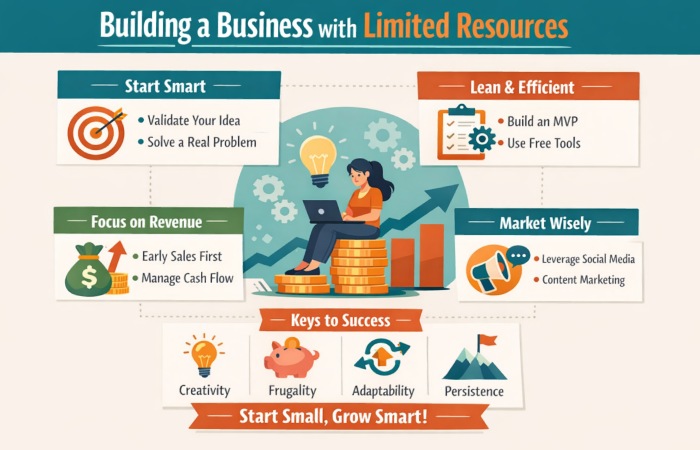
Building a business with limited resources means launching and growing a company with minimal capital, small teams, limited tools, and often without external funding. It involves prioritizing efficiency, creativity, and strategic thinking over spending.
Instead of focusing on what you lack, you leverage what you already have—skills, knowledge, network, and time.
Key Characteristics
| Aspect | Description |
| Low Initial Investment | Starting with minimal capital |
| Lean Operations | Small team or solo founder |
| Resource Optimization | Maximum output from minimal input |
| Gradual Scaling | Growing step-by-step instead of rapid expansion |
| High Creativity | Solving problems without expensive solutions |
Why Limited Resources Can Be an Advantage
Having limited resources might seem like a disadvantage, but it often leads to better decision-making and long-term sustainability.
Benefits of Starting Small
| Advantage | Explanation |
| Better Focus | Forces you to prioritize essential activities |
| Reduced Risk | Lower financial exposure if things don’t work out |
| Faster Learning | You adapt quickly due to hands-on involvement |
| Strong Foundation | Builds discipline and operational efficiency |
| Innovation | Constraints encourage creative solutions |
When you don’t have excess resources, every decision matters—and that sharpens your entrepreneurial instincts.
Adopting Lean Strategies for Maximum Impact
Employing a lean business model can be incredibly beneficial when funds are tight. Lean principles focus on minimizing waste and maximizing efficiency. By adopting methods like Just-In-Time production, you only create and distribute products as needed, significantly reducing overhead costs. Continuous improvement within your team ensures processes are frequently assessed and refined, leading to sustainable gains and cost savings over time. Studying successful examples can help you tailor a strategy that aligns with your unique business goals.
Step-by-Step Guide to Building Your Dream Business
Start with a Clear Business Idea
Your business idea doesn’t need to be revolutionary—it needs to solve a real problem.
Focus on:
- What skills you already have
- What problems you can solve
- What people are willing to pay for
Idea Validation
| Question | Purpose |
| Who is my target audience? | Identifies your market |
| What problem am I solving? | Defines your value |
| Why would people pay? | Tests profitability |
| Who are competitors? | Understands the market |
| What makes me different? | Builds uniqueness |
Use a Lean Business Model
A lean business model helps you minimize waste and maximize efficiency.
Lean Model Components
| Component | Description |
| Value Proposition | What makes your product valuable |
| Customer Segments | Who you serve |
| Revenue Streams | How you earn money |
| Cost Structure | Where you spend money |
| Channels | How you reach customers |
Instead of building everything at once, focus only on what is necessary to launch.
Build a Minimum Viable Product (MVP)
An MVP is the simplest version of your product that solves the core problem.
You don’t need perfection—you need functionality.
MVP Approach Comparison
| Approach | Traditional Business | Lean Startup |
| Development Time | Long | Short |
| Cost | High | Low |
| Risk | High | Controlled |
| Feedback | Late | Early |
| Flexibility | Low | High |
Launch quickly, gather feedback, and improve continuously.
Leverage Free and Low-Cost Tools
You don’t need expensive software to run a business today. There are countless free or affordable tools available.
Essential Tools for Startups
| Function | Tool Type | Example Use |
| Website Creation | Website builders | Build online presence |
| Marketing | Social media platforms | Promote products |
| Communication | Messaging tools | Talk to customers |
| Design | Graphic tools | Create branding |
| Finance | Budget trackers | Manage expenses |
Focus on tools that deliver value without increasing your costs significantly.
Build Your Brand Without Spending Big
Branding is not about expensive logos—it’s about consistency, trust, and value.
Low-Cost Branding Strategies
| Strategy | Description |
| Personal Branding | Use your story to connect with customers |
| Social Media | Share valuable content regularly |
| Content Marketing | Blogs, videos, and posts |
| Customer Experience | Deliver exceptional service |
| Word-of-Mouth | Encourage referrals |
A strong brand can be built with authenticity rather than money.
Focus on Revenue First
Many startups focus on growth before revenue—that’s risky when resources are limited.
Instead, prioritize:
- Early sales
- Cash flow
- Profitability
Revenue vs Growth Focus
| Factor | Revenue-First Approach | Growth-First Approach |
| Stability | High | Low |
| Risk | Lower | Higher |
| Funding Need | Minimal | High |
| Sustainability | Strong | Uncertain |
Making money early keeps your business alive.
Master Time Management
When resources are limited, time becomes your most valuable asset.
Time Optimization Techniques
| Technique | Benefit |
| Prioritization | Focus on high-impact tasks |
| Time Blocking | Structured work schedule |
| Automation | Reduce repetitive work |
| Delegation | Free up your time |
| Elimination | Remove unnecessary tasks |
Work smarter, not harder.
Build a Network Instead of Hiring
Instead of hiring full-time employees, collaborate with freelancers, partners, and mentors.
Networking Benefits
| Benefit | Explanation |
| Cost Savings | No full-time salary expenses |
| Flexibility | Scale team as needed |
| Expertise Access | Get specialized skills |
| Faster Execution | Complete tasks quickly |
Relationships can replace resources in many cases.
Market Smart, Not Expensive
Marketing doesn’t require a big budget—it requires strategy.
Low-Cost Marketing Channels
| Channel | Strategy |
| Social Media | Consistent posting |
| SEO | Organic traffic growth |
| Email Marketing | Direct communication |
| Partnerships | Cross-promotion |
| Communities | Engage niche audiences |
Focus on platforms where your audience already exists.
Scale Gradually and Sustainably
Growth should be controlled and strategic.
Scaling Strategy
| Stage | Focus |
| Early Stage | Validation and revenue |
| Growth Stage | Optimization |
| Expansion Stage | Scaling operations |
| Maturity | Stability and diversification |
Avoid growing faster than your resources allow.
Common Mistakes to Avoid
Even with limited resources, avoiding key mistakes can save your business.
Mistake Analysis
| Mistake | Impact | Solution |
| Overspending Early | Financial strain | Stick to a budget |
| Perfectionism | Delayed launch | Launch early |
| Ignoring Customers | Poor product-market fit | Gather feedback |
| Lack of Focus | Wasted effort | Prioritize key tasks |
| No Revenue Plan | Business failure | Monetize early |
Real-Life Examples of Low-Resource Success
Many successful businesses started with very limited resources.
Example Comparison
| Business Type | Starting Condition | Outcome |
| Online Store | Started from home | Global reach |
| Freelance Service | Solo founder | Agency growth |
| Content Creator | Minimal tools | Large audience |
| Tech Startup | MVP launch | Scaled product |
These examples prove that resources are not the deciding factor—execution is.
Mindset Required for Success
Your mindset plays a crucial role when resources are limited.
Key Traits
| Trait | Importance |
| Resilience | Overcome challenges |
| Adaptability | Adjust strategies quickly |
| Discipline | Stay consistent |
| Creativity | Solve problems innovatively |
| Patience | Long-term success |
A strong mindset can outperform a large budget.
Financial Planning for Limited Resources
Proper financial management ensures survival and growth.
Budget Allocation Example
| Category | Percentage |
| Product Development | 30% |
| Marketing | 25% |
| Operations | 20% |
| Tools & Software | 15% |
| Emergency Fund | 10% |
Track every expense and avoid unnecessary spending.
Final Thoughts
Building your dream business with limited resources is not about waiting for the perfect moment—it’s about taking action with what you already have. Constraints force clarity, discipline, and innovation—qualities that define successful entrepreneurs.