

Learning about business is one of the most valuable skills you can develop in today’s world. Whether you want to start your own company, grow a side hustle, or simply understand how organizations work, business knowledge gives you a powerful advantage. It allows you to make smarter decisions, manage money effectively, and recognize opportunities where others see problems.
Business is not a single subject but a combination of multiple disciplines working together. It includes marketing, finance, operations, leadership, and strategy. The most effective way to learn business is not just by studying theory but by combining knowledge with real-world experience. This guide explains how to do that in a structured and practical way.
What Does Learning Business Actually Mean?
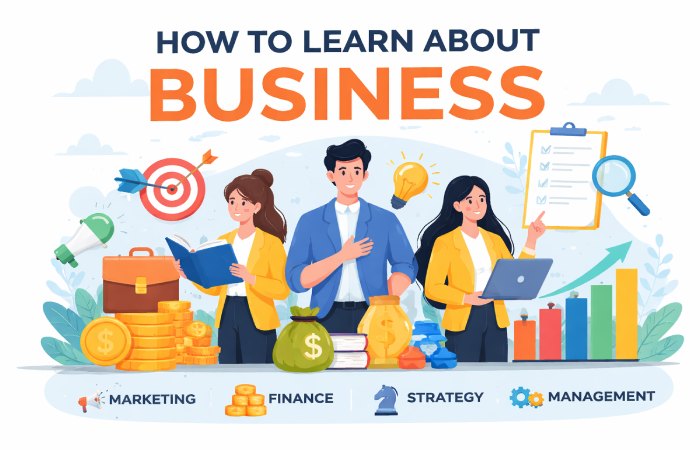
Learning business means understanding how organizations create value and generate profit. It involves studying how companies attract customers, manage resources, compete in markets, and sustain long-term growth. Business education also teaches decision-making, problem-solving, and adaptability.
Modern learning platforms emphasize that business education is not only about theory but also about developing practical skills such as strategic thinking and innovation. These skills help individuals succeed whether they are employees, freelancers, or entrepreneurs.
Core Areas You Need to Understand
To learn business effectively, you must first understand its core components. Each area plays a crucial role in how a business operates and grows.
| Area | What It Involves | Why It Matters |
| Marketing | Branding, advertising, customer behavior | Helps attract and retain customers |
| Finance | Budgeting, profit, cash flow | Ensures financial stability |
| Operations | Processes, supply chain | Improves efficiency |
| Management | Leadership, team coordination | Drives productivity |
| Strategy | Planning and competition analysis | Supports long-term growth |
| Entrepreneurship | Innovation and startups | Builds new opportunities |
Start with Business Fundamentals
Every learning journey should begin with the basics. Without a strong foundation, advanced concepts become difficult to understand. At this stage, you should focus on how businesses are structured and how they operate in different industries.
Understanding concepts such as supply and demand, pricing, cost structures, and business models is essential. These basics act as building blocks for more advanced topics like financial analysis and strategic planning. Taking time to master fundamentals ensures that you can confidently move forward without confusion.
Use Online Courses for Structured Learning
Online learning has made business education accessible to everyone. Platforms such as Coursera and Harvard Business School Online offer high-quality courses designed by experts.
These courses provide a structured path where topics are explained step by step. They often include real-world case studies, assignments, and interactive exercises. This structured approach helps learners understand how theoretical concepts apply in real business situations.
| Platform | Key Features | Ideal For |
| Coursera | University-level courses and certificates | Beginners to advanced learners |
| Harvard Business School Online | Premium and in-depth programs | Serious learners and professionals |
| Udemy | Affordable and flexible courses | Skill-focused learning |
| LinkedIn Learning | Career-oriented lessons | Working professionals |
Learn Through Reading and Research
Reading is one of the most effective ways to gain insights into business thinking. Books provide detailed explanations, real-life examples, and lessons from experienced entrepreneurs and business leaders.
However, reading should not be treated as the only method of learning. It works best when combined with practical application. When you read about a concept such as marketing or pricing, applying it in a real scenario helps you truly understand it.
| Type of Resource | What You Gain |
| Books | Deep knowledge and case studies |
| Articles | Updated trends and insights |
| Research papers | Analytical understanding |
| Blogs | Practical tips and strategies |
Learn by Doing: The Most Effective Method
Practical experience is the most important part of learning business. While theory provides knowledge, real-world practice builds understanding. Starting small projects allows you to test ideas and learn from outcomes.
You might begin with a simple online business, freelance service, or local selling activity. Through this process, you learn how customers behave, how pricing works, and how to solve problems in real time. Mistakes become valuable lessons rather than failures.
| Activity | Skills Developed |
| Starting a small business | Decision-making and risk management |
| Freelancing | Client handling and pricing |
| Selling products | Marketing and negotiation |
| Managing a project | Planning and execution |
Stay Updated with Business Trends
Business is constantly evolving, and staying updated is essential. Following current trends helps you understand how industries change and how companies adapt to new challenges.
Regularly reading business news and watching expert discussions allows you to connect theory with real-world events. This habit builds awareness and helps you think strategically about opportunities and risks.
| Source Type | Benefit |
| News websites | Real-time business updates |
| Podcasts | Convenient learning |
| YouTube channels | Visual explanations |
| Industry reports | In-depth analysis |
Learn from Real Businesses
Observing successful companies provides valuable insights into how strategies work in practice. By analyzing how businesses market their products, manage customers, and scale operations, you develop a deeper understanding of business dynamics.
This type of learning improves your ability to think critically. Instead of memorizing concepts, you start recognizing patterns and strategies that can be applied in different situations.
Importance of Financial Literacy
Finance is the backbone of every business. Without understanding money management, it is difficult to sustain or grow a business. Learning financial concepts helps you make informed decisions and avoid costly mistakes.
You need to understand how money flows in and out of a business, how profits are calculated, and how budgets are managed. These skills are essential whether you are running a company or managing personal finances.
| Concept | Explanation |
| Revenue | Total income generated |
| Profit | Earnings after expenses |
| Cash Flow | Movement of money |
| Break-even Point | When income equals expenses |
Developing the Right Mindset
Business success is not only about knowledge but also about mindset. An entrepreneurial mindset helps you see opportunities, adapt to changes, and stay resilient during challenges.
This mindset encourages continuous learning and experimentation. Instead of fearing failure, you begin to view it as part of the learning process. Over time, this approach builds confidence and decision-making ability.
Creating a Long-Term Learning Plan
Learning business is not something that happens overnight. It requires consistent effort over time. Creating a roadmap helps you stay focused and track your progress.
| Stage | Focus Area | Approach |
| Beginner | Fundamentals | Courses and basic reading |
| Intermediate | Skill development | Practical projects |
| Advanced | Strategy | Business analysis |
| Expert | Leadership | Mentoring and scaling |
Common Mistakes to Avoid
Many learners struggle because they focus too much on theory and avoid practical application. Others try to skip foundational knowledge, which leads to confusion later.
Another common issue is the fear of failure. In business, failure is often the best teacher. Avoiding action prevents real learning and growth. Understanding these mistakes early can save time and effort.
| Mistake | Impact |
| Ignoring fundamentals | Weak understanding |
| Avoiding practice | Lack of real skills |
| Fear of failure | Missed opportunities |
| Overloading information | Confusion |
Conclusion
Learning about business is a continuous journey that combines knowledge, observation, and experience. While courses and books provide the foundation, real understanding comes from applying what you learn in practical situations.
A balanced approach works best. Start with fundamentals, use structured learning resources, gain practical experience, and stay updated with trends. Over time, you will develop both the knowledge and the confidence needed to succeed in the business world.
The key is consistency. Business cannot be mastered overnight, but with steady learning and real-world practice, anyone can build strong business skills and create meaningful opportunities.