

Introduction
Planning for business success is one of the most essential steps in building a sustainable and profitable organization. Many businesses fail not because their ideas are weak, but because they lack a structured plan that outlines goals, strategies, finances, and operational processes. A well-developed business plan acts as a roadmap that guides entrepreneurs through every stage of growth—from startup to expansion.
Business planning allows companies to clearly define their mission, understand their target market, evaluate competition, and develop effective strategies to achieve long-term success. It also helps organizations identify potential risks and opportunities before investing significant resources. Investors and lenders often rely on business plans to evaluate the viability of a company before providing funding.
According to business planning experts, a comprehensive business plan typically includes sections such as an executive summary, company description, market analysis, marketing strategy, and financial projections. These elements help organizations explain their value proposition and demonstrate how they will generate revenue and grow in competitive markets.
The following sections explain the most important elements involved in planning for business success and how each component contributes to building a strong and sustainable organization.
Organizational Structure
Organizational structure defines how roles, responsibilities, authority, and communication flow within a company. A clear structure ensures that employees understand their duties and that management can coordinate tasks effectively.
A strong organizational structure also supports scalability. As businesses grow, they must adapt their management systems to maintain efficiency and accountability.
Key Elements of Organizational Structure
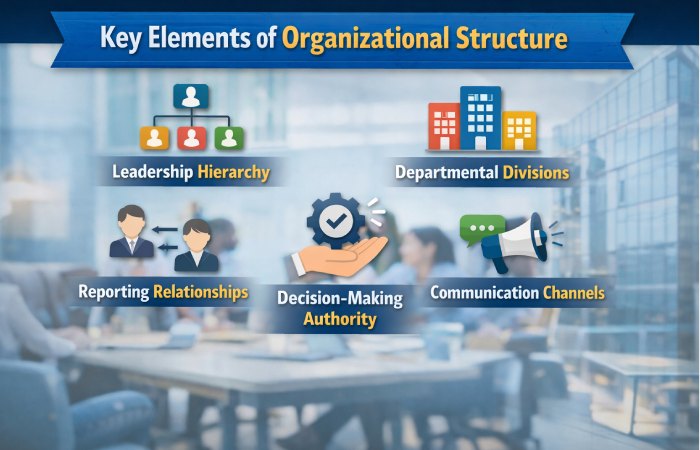
| Component | Description | Importance |
| Leadership hierarchy | Defines authority levels within the company | Ensures accountability |
| Departmental divisions | Organizes teams such as marketing, finance, and operations | Improves specialization |
| Reporting relationships | Clarifies who reports to whom | Prevents confusion |
| Communication channels | Defines internal communication flow | Enhances efficiency |
| Decision-making authority | Determines who makes strategic decisions | Speeds up processes |
Common Organizational Structures
| Structure Type | Characteristics | Best For |
| Functional Structure | Departments grouped by function | Medium to large companies |
| Flat Structure | Few management levels | Startups and small teams |
| Matrix Structure | Employees report to multiple managers | Complex projects |
| Divisional Structure | Organization divided by product or region | Large corporations |
A well-defined structure improves coordination between departments and allows companies to manage resources efficiently.
Personnel Development
Personnel development refers to the continuous improvement of employee skills, knowledge, and capabilities. Businesses rely heavily on their workforce to achieve strategic goals, so investing in employee development is critical.
Companies that focus on employee growth often experience higher productivity, stronger engagement, and improved innovation.
Personnel Development Strategies
| Development Method | Purpose | Benefits |
| Training programs | Improve technical and professional skills | Increased productivity |
| Workshops and seminars | Update knowledge on industry trends | Better decision-making |
| Mentorship programs | Experienced employees guide newcomers | Knowledge transfer |
| Performance evaluations | Measure employee performance | Continuous improvement |
| Leadership development | Prepare future managers | Organizational stability |
Key Benefits of Personnel Development
| Benefit | Impact on Business |
| Improved productivity | Employees perform tasks more efficiently |
| Higher employee retention | Staff feel valued and stay longer |
| Innovation and creativity | Employees generate new ideas |
| Strong leadership pipeline | Future managers are prepared |
Personnel development ensures that employees remain adaptable and capable of handling evolving business challenges.
Develop a True Vision
A clear vision is the foundation of any successful business. It defines where the organization wants to be in the future and inspires employees, investors, and customers.
A strong vision provides long-term direction and aligns the organization’s strategies and actions.
Vision Development Elements
| Vision Element | Description |
| Purpose | Why the company exists |
| Long-term goals | Desired achievements in the future |
| Core values | Principles guiding company decisions |
| Strategic direction | Steps needed to achieve goals |
Characteristics of a Strong Vision
| Characteristic | Explanation |
| Clear | Easy to understand |
| Inspirational | Motivates employees and stakeholders |
| Future-focused | Looks beyond short-term goals |
| Realistic | Achievable with proper strategy |
Businesses with a compelling vision can inspire teams and build strong organizational culture.
The Executive Summary
The executive summary is a concise overview of the entire business plan. Although it appears first in the document, it is typically written last after all other sections are completed.
Its primary goal is to quickly communicate the business idea, objectives, and growth potential to investors or stakeholders.
Experts recommend keeping the executive summary clear and compelling because it often determines whether investors continue reading the full plan.
Executive Summary Components
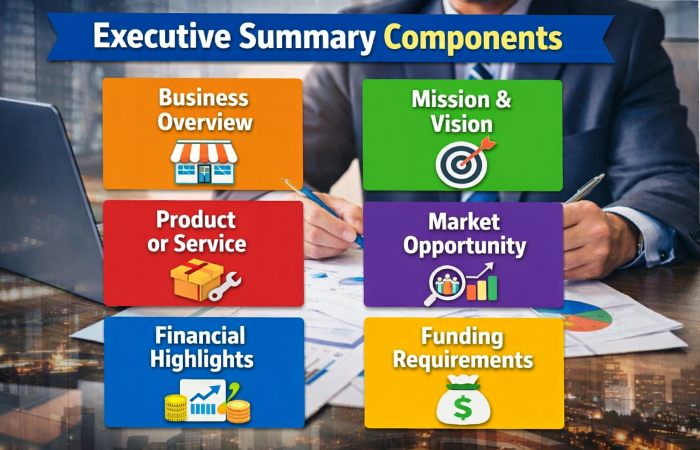
| Component | Description |
| Business overview | Introduction to the company |
| Mission and vision | Purpose and long-term goals |
| Product or service | What the business offers |
| Market opportunity | Target market and demand |
| Financial highlights | Revenue projections |
| Funding requirements | Capital needed for growth |
Why the Executive Summary Matters
| Reason | Explanation |
| Investor attraction | Captures investor interest |
| Quick overview | Summarizes the business idea |
| Strategic clarity | Highlights business goals |
A Description of the Business
The business description explains the nature of the company, its goals, and its competitive advantages.
This section helps stakeholders understand what the company does and how it plans to succeed.
Business Description Elements
| Element | Details |
| Business name | Official company identity |
| Legal structure | Sole proprietorship, partnership, corporation |
| Industry sector | Market category |
| Company mission | Purpose of the organization |
| Unique selling proposition | Competitive advantage |
Example Business Models
| Business Model | Description |
| Product-based | Selling physical goods |
| Service-based | Offering professional services |
| Subscription | Recurring payments for access |
| Marketplace | Connecting buyers and sellers |
A clear business description helps establish credibility and clarity.
The Market(s) the Business Will Operate In
Market analysis identifies potential customers, competitors, and industry trends.
Understanding the market allows companies to position themselves strategically and identify growth opportunities.
Market Analysis Factors
| Factor | Explanation |
| Market size | Total potential customers |
| Market growth rate | Expected industry expansion |
| Target audience | Specific customer group |
| Customer needs | Problems customers want solved |
| Competitor analysis | Evaluation of competing businesses |
Market Research Methods
| Method | Purpose |
| Surveys | Collect customer feedback |
| Industry reports | Understand trends |
| Competitor analysis | Study competitor strategies |
| Online analytics | Track consumer behavior |
Market analysis helps businesses align their strategies with real customer needs.
A SWOT Analysis
A SWOT analysis evaluates the internal and external factors affecting a business.
It helps companies identify strategic opportunities and potential risks.
SWOT Analysis Framework
| Factor | Description |
| Strengths | Internal advantages |
| Weaknesses | Internal limitations |
| Opportunities | External growth possibilities |
| Threats | External risks |
Example SWOT Analysis
| Category | Example |
| Strength | Strong brand reputation |
| Weakness | Limited financial resources |
| Opportunity | Growing market demand |
| Threat | Intense competition |
SWOT analysis helps organizations develop strategies that leverage strengths while addressing weaknesses.
Management Team and Personnel
The management team is responsible for strategic decision-making and operational leadership.
Investors often evaluate the leadership team when deciding whether to support a business.
Key Management Roles
| Role | Responsibilities |
| CEO | Strategic leadership |
| Operations Manager | Oversees daily operations |
| Marketing Manager | Handles marketing campaigns |
| Financial Manager | Manages financial planning |
| HR Manager | Handles recruitment and employee relations |
Qualities of Strong Leadership
| Quality | Impact |
| Strategic thinking | Long-term planning |
| Decision-making | Efficient management |
| Communication | Strong teamwork |
| Adaptability | Handling change |
Strong leadership is essential for guiding the organization toward its goals.
The Products or Services Offered
The product or service section explains what the business sells and how it solves customer problems.
Product Development Elements
| Element | Description |
| Features | Characteristics of the product |
| Benefits | Value delivered to customers |
| Pricing strategy | Cost structure |
| Competitive advantage | Differentiation from competitors |
Product Lifecycle Stages
| Stage | Description |
| Introduction | Product launch |
| Growth | Increasing sales |
| Maturity | Market saturation |
| Decline | Decreasing demand |
Understanding product lifecycle helps businesses plan innovation strategies.
Marketing
Marketing strategies help businesses attract customers and build brand awareness.
A successful marketing plan typically includes pricing, promotion, distribution, and product positioning strategies.
Marketing Strategies
| Strategy | Purpose |
| Content marketing | Educate customers through articles |
| Social media marketing | Build brand awareness |
| SEO | Improve search engine visibility |
| Email marketing | Direct communication with customers |
| Paid advertising | Increase reach quickly |
Marketing Mix (4Ps)
| Element | Explanation |
| Product | What you sell |
| Price | How much customers pay |
| Place | Where the product is sold |
| Promotion | How customers learn about it |
Marketing is essential for building customer relationships and increasing sales.
A Financial Plan
The financial plan outlines how the business will generate revenue and manage expenses.
Financial projections are crucial for evaluating the feasibility of a business idea.
Financial Plan Components
| Component | Description |
| Startup costs | Initial expenses |
| Revenue projections | Expected income |
| Profit and loss statement | Financial performance |
| Cash flow statement | Money movement |
| Break-even analysis | When profits equal costs |
Financial Planning Benefits
| Benefit | Impact |
| Budget control | Prevent overspending |
| Investor confidence | Attract funding |
| Risk management | Identify financial threats |
Financial planning ensures the business remains financially stable.
Risk Management
Risk management involves identifying potential threats and preparing strategies to minimize their impact.
Businesses face risks related to finances, operations, competition, and market changes.
Types of Business Risks
| Risk Type | Example |
| Financial risk | Cash flow shortages |
| Operational risk | System failures |
| Market risk | Changing customer demand |
| Legal risk | Regulatory changes |
Risk Mitigation Strategies
| Strategy | Purpose |
| Diversification | Reduce dependence on one product |
| Insurance | Protect against financial losses |
| Compliance monitoring | Avoid legal penalties |
| Emergency planning | Prepare for disruptions |
Effective risk management ensures long-term business stability.
Conclusion
Planning for business success requires a structured and strategic approach. A comprehensive business plan includes multiple components such as organizational structure, personnel development, market analysis, marketing strategies, and financial planning.
Each of these elements plays a vital role in guiding businesses toward growth and sustainability. By clearly defining their vision, understanding their market, and managing financial resources effectively, organizations can create a strong foundation for long-term success.
A well-designed business plan not only improves internal decision-making but also builds credibility with investors, partners, and stakeholders. Ultimately, businesses that prioritize strategic planning are better prepared to navigate challenges, seize opportunities, and achieve sustainable growth in competitive markets.