

Introduction
Starting or expanding a business often requires significant financial resources. Many entrepreneurs rely on external funding to cover expenses such as equipment purchases, inventory, working capital, and infrastructure. One of the most common financing options available is a business loan.
A business loan provides financial support to companies that need capital for growth, operations, or expansion. Banks, non-banking financial companies (NBFCs), and government institutions offer these loans with varying interest rates, repayment terms, and eligibility criteria.
In countries like India, business loans play a crucial role in supporting Micro, Small, and Medium Enterprises (MSMEs). These enterprises are the backbone of the economy, generating employment and promoting innovation. Governments and financial institutions provide special schemes and subsidies to encourage entrepreneurship and economic development.
This article explains everything about business loans, including types, interest rates, government schemes, eligibility, documentation, advantages, and examples.
What Is a Business Loan?
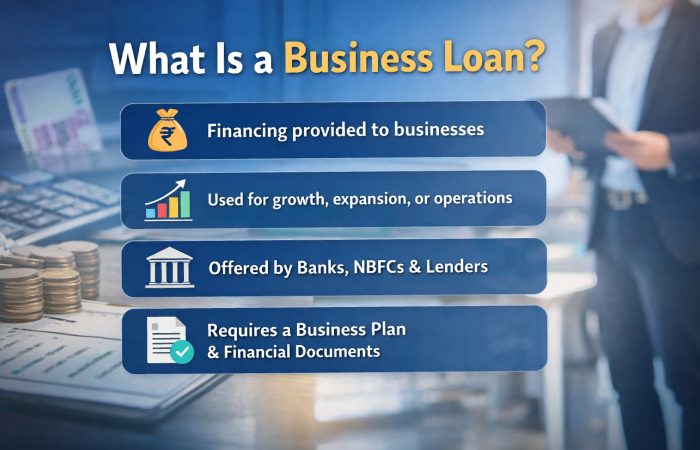
A business loan is a type of financial assistance provided by banks or lenders to entrepreneurs or companies to support business activities such as expansion, purchasing equipment, managing cash flow, or starting a new venture.
Unlike personal loans, business loans are specifically designed for commercial purposes. They usually require a business plan, financial statements, and proof of business operations.
Key Features of Business Loans
| Feature | Description |
| Purpose | Used for starting, expanding, or operating a business |
| Lenders | Banks, NBFCs, government institutions, fintech companies |
| Loan Amount | Depends on business size and financial strength |
| Interest Rate | Usually between 8% and 24% per year depending on lender |
| Repayment Period | Usually 1–10 years |
| Security | Can be secured or unsecured |
Business loans allow companies to maintain cash flow and invest in growth without giving up ownership or equity.
Types of Business Loan
There are several types of business loans available depending on the financial needs of the company.
-
Term Loan
A term loan is a traditional loan where the borrower receives a fixed amount and repays it over a specific period with interest.
| Feature | Details |
| Loan Amount | Medium to large |
| Repayment | Monthly EMI |
| Tenure | 1–10 years |
| Use | Expansion, equipment purchase |
-
Working Capital Loan
Working capital loans are used to manage daily operational expenses such as salaries, rent, and inventory.
| Feature | Details |
| Purpose | Short-term operating costs |
| Tenure | 6 months – 3 years |
| Borrowers | Small and medium businesses |
-
Equipment Financing
| Feature | Details |
| Purpose | Buying machinery or equipment |
| Collateral | Equipment itself |
| Tenure | 3–7 years |
-
Invoice Financing
Invoice financing allows businesses to borrow money against unpaid invoices.
| Feature | Details |
| Use | Improve cash flow |
| Funding | Up to 80–90% of invoice value |
| Best For | Businesses with delayed payments |
-
Government Business Loans
Government-backed loans provide financial assistance to small businesses through subsidies and guarantees.
| Scheme | Loan Limit |
| Mudra Loan | Up to ₹10 lakh |
| Stand-Up India | ₹10 lakh – ₹1 crore |
| PMEGP | Up to ₹50 lakh |
These schemes help entrepreneurs start or expand businesses with lower interest rates and minimal collateral.
Why Is a Business Loan Important?
Business loans play a vital role in supporting entrepreneurship and economic growth. They help companies overcome financial limitations and achieve long-term goals.
Key Reasons Businesses Need Loans
| Reason | Explanation |
| Business Expansion | Opening new branches or markets |
| Equipment Purchase | Buying machinery or technology |
| Cash Flow Management | Managing operational costs |
| Hiring Employees | Expanding workforce |
| Inventory Purchase | Buying raw materials or stock |
Business loans are often preferred because they allow companies to access funding without giving up equity ownership.
What Is Business Loan Interest Rate?
The business loan interest rate is the percentage charged by lenders on the borrowed amount.
Average Business Loan Interest Rates
| Lender Type | Interest Rate Range |
| Public Sector Banks | 8.5% – 11.5% |
| Private Banks | 9% – 14% |
| NBFCs / Fintech Lenders | 11% – 24% |
Interest rates vary depending on:
- Credit score
- Business turnover
- Loan amount
- Loan tenure
- Risk profile of the business
Government schemes often offer lower interest rates due to subsidies and credit guarantees.
Business Loan by Government
Many governments provide financial assistance to encourage entrepreneurship and support small businesses.
Popular Government Business Loan Schemes
| Scheme | Description | Loan Limit |
| Mudra Loan (PMMY) | Collateral-free loans for small businesses | Up to ₹10 lakh |
| PMEGP | Subsidized loan for new businesses | Up to ₹50 lakh |
| Stand-Up India | Loans for women and SC/ST entrepreneurs | ₹10 lakh – ₹1 crore |
| CGTMSE | Government guarantee for collateral-free loans | Up to ₹5 crore |
The Credit Guarantee Fund Trust for Micro and Small Enterprises (CGTMSE) helps small businesses obtain loans without collateral by guaranteeing repayment to lenders.
Government loan schemes encourage entrepreneurship by reducing borrowing costs and increasing access to finance.
How to Apply for a Business Loan
Applying for a business loan usually involves a structured process.
Steps to Apply
| Step | Description |
| Step 1 | Determine loan amount and purpose |
| Step 2 | Choose the right lender or scheme |
| Step 3 | Prepare required documents |
| Step 4 | Submit application online or at bank |
| Step 5 | Credit assessment by lender |
| Step 6 | Loan approval and disbursement |
Application Channels
- Bank branches
- Online banking portals
- Government loan portals
- Fintech lending platforms
Digital lending platforms have made the process faster and easier.
Documents Required for Business Loan
To apply for a business loan, applicants must submit certain documents to verify identity, financial stability, and business credibility.
Common Documents Required
| Document Type | Examples |
| Identity Proof | Aadhaar Card, Passport, PAN Card |
| Address Proof | Utility bill, rental agreement |
| Business Proof | GST registration, business license |
| Financial Documents | Bank statements, ITR |
| Business Plan | Project report for loan usage |
| Ownership Proof | Partnership deed or company registration |
Providing accurate documentation increases the chances of loan approval.
Business Loan Eligibility
Lenders evaluate several factors before approving a business loan.
Basic Eligibility Criteria
| Criteria | Requirement |
| Age | Usually 21–65 years |
| Business Vintage | At least 1–3 years |
| Credit Score | 700 or above preferred |
| Annual Turnover | Depends on lender |
| Business Type | Proprietorship, partnership, company |
Businesses with stable revenue and good financial records are more likely to receive loan approval.
Advantages of Business Loan
Business loans offer multiple benefits for entrepreneurs and companies.
Major Advantages
| Advantage | Explanation |
| Quick Access to Capital | Provides immediate funds |
| Business Expansion | Helps scale operations |
| Flexible Repayment | Various tenure options |
| Tax Benefits | Interest payments are tax-deductible |
| No Equity Loss | Owner retains full control |
These benefits make business loans a popular funding option for small and medium enterprises.
Business Loan Example
Let’s look at a simple example to understand how a business loan works.
Example Scenario
Suppose a small manufacturing company needs ₹10 lakh to purchase machinery.
| Detail | Value |
| Loan Amount | ₹10,00,000 |
| Interest Rate | 10% per year |
| Loan Tenure | 5 years |
| Monthly EMI | Approx. ₹21,247 |
The company uses the machinery to increase production and generate additional revenue, allowing it to repay the loan comfortably.
Business Loan: Secured or Unsecured?
Business loans can be classified into two main categories.
Secured Business Loan
| Feature | Description |
| Collateral | Required |
| Interest Rate | Lower |
| Loan Amount | Higher |
| Risk | Lower for lender |
Examples of collateral:
- Property
- Machinery
- Vehicles
Unsecured Business Loan
| Feature | Description |
| Collateral | Not required |
| Interest Rate | Higher |
| Loan Amount | Usually smaller |
| Approval | Based on creditworthiness |
Many government schemes provide collateral-free loans to support small businesses.
Conclusion
Business loans are an essential financial tool that helps entrepreneurs start, sustain, and expand their ventures. Whether a company needs funds for working capital, equipment purchases, or business expansion, loans provide a reliable source of financing.
With the growth of digital lending platforms and government support programs, accessing business loans has become easier than ever. Entrepreneurs can choose from various options, including secured loans, unsecured loans, and government-subsidized schemes.
However, before applying for a business loan, it is important to evaluate interest rates, repayment capacity, and loan terms carefully. Proper planning and responsible borrowing can help businesses achieve long-term growth and financial stability.