

Brand ambassadors are not just promoters—they are structured trust assets that compound brand equity, reduce acquisition costs, and increase retention when managed as a long-term system rather than a campaign.
Most companies say they “have ambassadors.” What they often have instead are short-term promoters, loosely managed influencers, or affiliates posting occasionally for perks. Meanwhile, customer acquisition costs climb, ad performance fluctuates, and brand loyalty weakens. This gap between effort and impact explains why many ambassador programs feel busy but produce little measurable growth.
A brand ambassador is a person who represents and advocates for a brand consistently over time, influencing their audience through authentic experience rather than one-off promotion. When designed properly, ambassador programs create ongoing trust that drives awareness, conversions, and retention simultaneously.
This article is for beginners who want a clear explanation and for marketers, founders, and professionals evaluating whether ambassador programs can produce real ROI. It is not for organizations looking for a quick promotional hack. True ambassador systems require patience, structure, and relationship management.
What Is a Brand Ambassador?
A brand ambassador is an individual who consistently represents a company’s products, values, and voice to a specific audience through authentic engagement. Unlike traditional advertising, the influence comes from perceived independence and real experience.
Ambassadors can be customers, employees, creators, students, or industry experts. Their influence may occur online through social platforms, or offline through events, communities, and professional networks.
Two characteristics distinguish true ambassadors from other promoters: duration and identification. The relationship is ongoing, and the ambassador personally aligns with the brand’s mission or lifestyle.
| Attribute | True Brand Ambassador | Short-Term Promoter |
| Duration | Ongoing | Temporary |
| Motivation | Alignment + benefits | Payment or perks |
| Content Style | Natural integration | Explicit promotion |
| Trust Level | High | Variable |
| Brand Knowledge | Deep | Limited |
| Community Influence | Relationship-based | Reach-based |
Because ambassadors operate over time, they build familiarity. Familiarity builds trust. Trust lowers resistance to purchase decisions.
Brand Ambassador vs Influencer vs Affiliate
These roles overlap in practice, but strategically they serve different purposes. Misunderstanding this distinction leads to poor hiring decisions and unrealistic expectations.
Influencers specialize in attention. Affiliates specialize in measurable sales. Ambassadors specialize in sustained advocacy.
| Dimension | Brand Ambassador | Influencer | Affiliate |
| Relationship | Long-term | Campaign-based | Transactional |
| Primary Goal | Advocacy | Reach | Sales |
| Compensation | Mixed | Fixed payment | Commission |
| Content Integration | Continuous | Sponsored posts | Promotional links |
| Trust Depth | High | Medium | Medium |
| Longevity of Impact | Long | Short | Moderate |
A company launching a new product may use influencers for quick visibility. An e-commerce store focused on direct sales may rely on affiliates. But organizations seeking durable reputation and community growth benefit most from ambassador programs.
Types of Brand Ambassadors
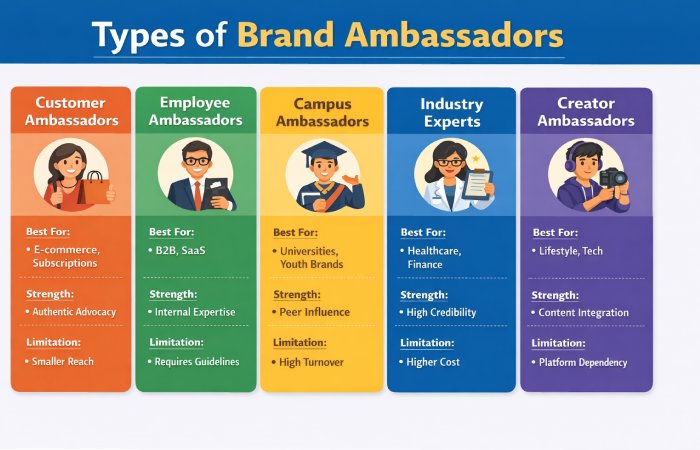
Different industries require different ambassador profiles. Matching the type to the business model is critical.
Customer Ambassadors
Loyal users who share experiences voluntarily or with modest incentives. They provide authenticity that cannot be manufactured.
Employee Ambassadors
Employees who publicly represent company culture and expertise. Particularly effective in professional services and B2B sectors where trust in people outweighs trust in logos.
Campus Ambassadors
Students who promote brands within universities through peer networks, events, and digital communities.
Industry Experts
Recognized professionals whose endorsement signals authority. Common in healthcare, finance, and technical fields where credibility is paramount.
Creator Ambassadors
Content creators who integrate the brand into their identity over time rather than featuring it occasionally.
| Ambassador Type | Best For | Strength | Limitation |
| Customer | Consumer products | Authenticity | Smaller reach |
| Employee | B2B & services | Authority | Requires guidelines |
| Campus | Youth markets | Peer influence | High turnover |
| Expert | Regulated sectors | Credibility | Higher cost |
| Creator | Lifestyle brands | Content output | Platform risk |
No single type is universally superior. Effective programs often combine several categories.
What Brand Ambassadors Actually Do
Ambassadors contribute across multiple stages of the customer journey, from discovery to retention. Their activities are not limited to posting promotional content.
They create social proof, answer questions, demonstrate real-world use cases, and provide feedback that improves products.
| Activity | Strategic Purpose | Typical Frequency |
| Social sharing | Awareness | Weekly |
| Reviews/testimonials | Trust building | Monthly |
| Community interaction | Authority | Ongoing |
| Event participation | Engagement | Quarterly |
| Referral sharing | Acquisition | Ongoing |
| Product feedback | Improvement | Periodic |
Consistency is more important than intensity. A steady stream of authentic interactions builds stronger perception than occasional high-volume promotion.
Why Ambassador Programs Drive Revenue
Ambassador programs influence revenue indirectly through trust and directly through referrals. Their economic impact emerges over time rather than immediately.
Trust Improves Conversion
Prospects who encounter a product through someone they trust enter the decision process with lower skepticism. Research organizations such as Nielsen consistently report that personal recommendations rank among the most trusted information sources globally.
Lower Customer Acquisition Cost
Paid advertising scales linearly with spending. Ambassador advocacy compounds. Once relationships are established, ongoing promotion requires less incremental investment.
| Acquisition Channel | Cost Behavior | Longevity |
| Paid Ads | Linear | Stops with budget |
| Influencer Campaign | Spike-based | Short |
| SEO Content | Compounding | Long |
| Ambassador Advocacy | Compounding | Long |
Higher Lifetime Value
Customers acquired through trusted channels tend to be better aligned with the product. Studies discussed in Harvard Business Review indicate that referral customers often show higher loyalty and retention.
Social Proof Flywheel
Every ambassador interaction produces content, testimonials, and conversations that reinforce brand legitimacy. Behavioral science research by Robert Cialdini highlights social proof as a key driver of persuasion, explaining why visible advocacy influences new buyers.
How to Build a Brand Ambassador Program
Successful programs are engineered, not improvised. Structure determines outcomes.
Step 1: Define Objectives
Different goals require different program designs.
| Objective | Program Focus | Key Metrics |
| Awareness | Content volume | Reach, mentions |
| Sales | Referrals | Conversions |
| Retention | Community | Churn rate |
| Expansion | Market entry | New users |
Without clear objectives, evaluation becomes impossible.
Step 2: Identify Ideal Ambassadors
Selection should prioritize alignment over popularity. Candidates should demonstrate genuine enthusiasm, communication ability, and credibility within their communities.
Micro-influencers or ordinary customers often outperform celebrities in engagement quality.
Step 3: Recruitment Channels
Ambassadors can be sourced from existing customers, online communities, professional networks, events, or employee referrals. Recruiting from satisfied users typically produces higher authenticity.
Step 4: Incentive Design
Incentives shape behavior. Overly sales-driven rewards can damage trust, while purely symbolic rewards may fail to motivate.
| Incentive Type | Best Use Case | Risk |
| Free products | Consumer goods | Limited monetary value |
| Commission | Sales focus | Over-promotion |
| Stipend | Professional roles | Higher cost |
| Hybrid | Scaling programs | Complexity |
| Recognition/status | Community brands | Requires culture |
Balanced programs combine material benefits with recognition and access.
Step 5: Onboarding and Support
Ambassadors need guidance but not rigid scripts. Provide brand messaging, disclosure requirements, and communication channels while preserving authenticity.
Step 6: Measurement and Optimization
Effective tracking focuses on outcomes rather than vanity metrics.
| Metric Category | Examples | Why It Matters |
| Acquisition | Referral conversions | Revenue impact |
| Engagement | Meaningful interactions | Influence quality |
| Retention | Repeat usage | Long-term value |
| Content output | Authentic assets | Social proof |
| Cost efficiency | CAC vs other channels | ROI |
Common Mistakes That Kill Programs
Many ambassador initiatives fail because they are treated as marketing experiments rather than relationship systems.
| Mistake | Consequence |
| Recruiting for reach only | Low authenticity |
| Over-controlling messaging | Loss of credibility |
| Poor communication | Declining motivation |
| Misaligned incentives | Aggressive selling |
| No measurement | Unclear value |
| Short-term expectations | Premature cancellation |
Ambassadors require ongoing engagement, recognition, and feedback.
Ambassador Programs vs Paid Advertising
Ambassador programs are not replacements for advertising but complements with different strengths.
| Factor | Ambassador Program | Paid Advertising |
| Trust | High | Moderate |
| Speed | Slow build | Immediate |
| Longevity | Ongoing | Temporary |
| Control | Shared | Full |
| Cost Efficiency | Improves over time | Often declines |
| Brand Equity | Strong | Limited |
The most resilient growth strategies combine both approaches: ads for acceleration, ambassadors for durability.
Industry-Specific Applications
Ambassador effectiveness varies by sector.
| Industry | Primary Benefit | Example Use |
| SaaS | Adoption + retention | User communities |
| E-commerce | Conversion + UGC | Product reviews |
| Startups | Low-cost growth | Early traction |
| Professional services | Credibility | Expert voices |
| Local business | Word-of-mouth | Community leaders |
For local businesses, community ambassadors can dominate reputation within geographic areas. For software companies, power users often become influential advocates.
Regulatory and Disclosure Considerations
Endorsement transparency is required in many regions. In the United States, the Federal Trade Commission mandates disclosure of material relationships. European regulations similarly emphasize consumer protection and transparency.
Programs should train ambassadors on disclosure practices to avoid legal and reputational risks.
The Future of Brand Ambassadorship
Several trends are reshaping this field:
- Growth of micro-communities over mass audiences
- Expansion of employee personal branding
- Integration with creator economy platforms
- Increasing importance of human credibility in an AI-saturated content environment
As automated content becomes ubiquitous, authentic human advocacy becomes a scarce resource. Brands that cultivate real relationships will hold a competitive advantage.
Final Thoughts
Brand ambassadors represent a shift from transactional marketing to relational growth. They transform satisfied individuals into long-term representatives of the brand’s reputation.
When built as a structured system—with clear objectives, aligned incentives, governance, and measurement—ambassador programs generate compounding returns that traditional campaigns struggle to match.