

Creating a business plan is one of the most important steps in launching and growing a successful venture. It acts as a roadmap, guiding entrepreneurs through strategy, operations, and financial planning. However, many business plans fail not because the idea is weak, but because of avoidable mistakes during the planning process. In fact, poor planning, unrealistic assumptions, and lack of research are among the most common pitfalls that can derail a business before it even begins.
This article explores the most common business plan mistakes, explains why they occur, and provides actionable strategies to avoid them. With a balance of detailed explanations and structured tables, this guide will help entrepreneurs, startups, and business owners create effective and investor-ready plans.
Introduction to Business Plan Mistakes
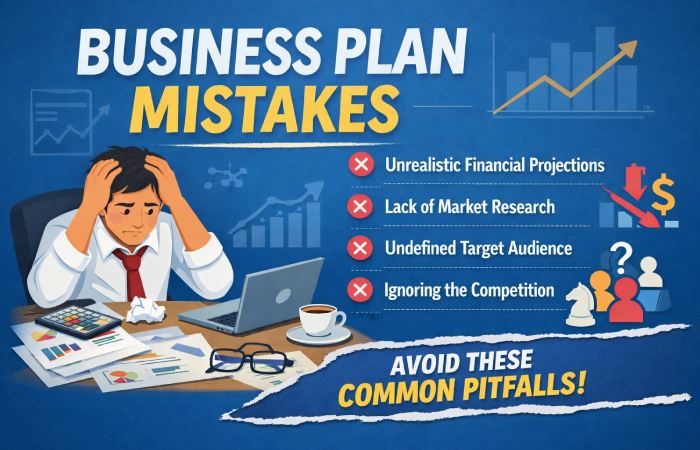
A business plan is more than just a document—it is a strategic tool that outlines your goals, target market, financial projections, and operational strategies. When done correctly, it helps secure funding, attract partners, and guide decision-making. However, when done poorly, it can mislead stakeholders and result in financial losses.
Many entrepreneurs treat a business plan as a one-time requirement rather than a living document. This approach often leads to outdated strategies and missed opportunities.
Why Business Plans Fail
Business plans fail due to a combination of strategic, operational, and psychological errors. Overconfidence, lack of market understanding, and insufficient financial planning are key contributors.
Key Reasons for Failure
| Reason | Explanation | Impact on Business |
| Over-optimism | Unrealistic revenue and growth projections | Financial instability |
| Poor research | Lack of reliable market data | गलत decisions |
| Undefined target market | अस्पष्ट audience | Low sales |
| Static planning | Plan not updated regularly | Irrelevance |
| Weak value proposition | No clear competitive advantage | Loss of investors |
Over-optimism is particularly dangerous. Many entrepreneurs overestimate market size and expected revenue, which can lead to unrealistic expectations and eventual disappointment.
Top Business Plan Mistakes to Avoid
Treating the Business Plan as a One-Time Document
One of the most common mistakes is creating a business plan and never revisiting it. A business operates in a dynamic environment where market trends, customer behavior, and competition constantly change.
A static plan quickly becomes obsolete. Instead, entrepreneurs should review and update their plans regularly to reflect real-world conditions.
Lack of Market Research
Market research is the foundation of any successful business plan. Without it, entrepreneurs rely on assumptions rather than facts.
Common Research Mistakes
| Mistake | Description | Solution |
| Using outdated data | يعتمد على معلومات قديمة | Use current industry reports |
| Ignoring competitors | No competitive analysis | Study competitors deeply |
| عدم فهم العملاء | No customer insights | Conduct surveys/interviews |
Poor research can lead to launching products that customers do not need, ultimately causing business failure.
Unrealistic Financial Projections
Financial projections are crucial for attracting investors. However, many business plans include overly optimistic forecasts without proper justification.
Financial Planning Errors
| Error | Example | Consequence |
| Inflated revenue | Expecting rapid growth | Investor distrust |
| Ignoring costs | Missing hidden expenses | Cash flow issues |
| No break-even analysis | Lack of clarity | Poor planning |
A realistic financial plan should include conservative estimates, detailed cost analysis, and contingency planning.
Undefined Target Market
A business cannot succeed if it tries to serve everyone. Defining a clear target audience is essential.
Target Market Mistakes
| Issue | Explanation | Fix |
| Broad audience | “Everyone is my customer” | Define niche segments |
| No demographics | Missing age, income, etc. | Build customer profiles |
| No pain point | Problem not identified | Focus on solutions |
Failing to identify a target market significantly increases the risk of failure.
Ignoring Competition
Many entrepreneurs underestimate or ignore their competitors. This can lead to weak positioning and poor strategic decisions.
Competitive Analysis Errors
| Mistake | Result | Solution |
| No competitor research | Lack of awareness | Analyze competitors |
| Underestimating rivals | Weak strategy | Benchmark performance |
| No differentiation | No unique value | Define USP |
A strong business plan clearly explains how the business stands out from competitors.
Poorly Written Plan
Presentation matters. A business plan filled with grammatical errors, poor formatting, or unclear language creates a negative impression.
Writing Mistakes
| Problem | Impact | Solution |
| Spelling errors | Lack of professionalism | Proofread |
| Complex language | Hard to understand | Use simple language |
| Poor structure | Confusing document | Follow standard format |
Even small errors can reduce credibility with investors.
Lack of Clear Value Proposition
A business plan must clearly explain what makes the business unique. Without this, it becomes difficult to attract customers or investors.
Value Proposition Issues
| Issue | Explanation | Fix |
| No differentiation | Same as competitors | Highlight uniqueness |
| Weak benefits | Not solving real problem | Focus on customer value |
| अस्पष्ट messaging | Confusing pitch | Simplify communication |
A strong value proposition answers the question: Why should customers choose you?
Ignoring Risks and Challenges
Many business plans focus only on opportunities and ignore potential risks. This creates an unrealistic picture.
Risk Management Mistakes
| Mistake | Impact | Solution |
| No risk analysis | Unexpected failures | Identify risks |
| No contingency plan | Unprepared for crises | Plan alternatives |
| Overconfidence | Poor decision-making | Stay realistic |
Acknowledging risks shows investors that you are prepared and strategic.
Using Generic Templates Without Customization
Templates can be helpful, but relying on them without customization leads to generic and ineffective plans.
Template Mistakes
| Problem | Result | Solution |
| Copy-paste content | Lack of originality | Customize content |
| Irrelevant sections | Confusing plan | Tailor to business |
| No personalization | Weak strategy | Add unique insights |
A business plan should reflect the specific needs and goals of your business.
Weak Executive Summary
The executive summary is often the first (and sometimes only) section investors read. A weak summary can result in immediate rejection.
Executive Summary Mistakes
| Mistake | Impact | Solution |
| Too long | Loss of interest | Keep concise |
| Lack of clarity | Confusion | Be direct |
| Missing key info | Incomplete picture | Include highlights |
A strong executive summary should be clear, concise, and compelling.
Best Practices to Avoid Business Plan Mistakes
Strategic Recommendations
| Best Practice | Description |
| नियमित अपडेट | Keep plan dynamic |
| Data-driven decisions | Use reliable sources |
| Customer focus | Understand needs |
| Realistic projections | Avoid overestimation |
| Professional presentation | Maintain quality |
Conclusion
A well-crafted business plan is essential for success, but avoiding common mistakes is just as important as including the right elements. From unrealistic financial projections to poor market research, these errors can significantly impact your business outcomes.
The key takeaway is that a business plan should be a living, evolving document—not a static requirement. By focusing on clarity, research, realistic assumptions, and continuous improvement, entrepreneurs can create powerful plans that drive long-term success.
Avoiding these business plan mistakes not only increases your chances of securing funding but also ensures that your business is built on a solid foundation.